
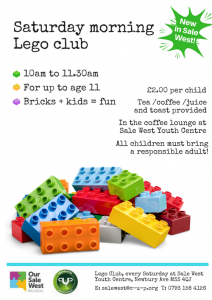
 In May 2018 we started a Saturday morning LEGO club in Sale West Community Centre as a way for parents to spend quality time with their children. Eight months in and the club has 20 families registered, that’s a total of 35 children, and we have two regular volunteers.
Tea toast and LEGO
Our recipe is pretty simple: supply tea, toast and boxes of bricks to adults and children under 11 and let them build what they want. We added in a few flourishes, such as Blind Builds (stick your hands in a bag of bricks and build something in there without looking), Challenge Cards and LEGO Bingo.
We found that kids loved the sense of achievement of building something (we take pictures at the end of each session and stick them on the wall the next week, so everyone can point and say “I made that”). Families are also pleased that children from different age ranges can come along to something together.
Welcome to your community centre
Many parents had never been in the community centre before, so the club is a good starting point for connecting them in to other activities and services that are based at the centre. It’s also a good way to show people that volunteering can be a fun and relaxed thing to do. We have two regular volunteers. They’re both local teenagers and started helping us out because they were a bit bored.
Building good communication skills
One of the children at the club’s school had suggested ‘LEGO-based therapy’ in his care plan (he has additional needs). Neither his parents or us knew what this meant so we set off to find out.
It turns out that research shows that building with LEGO can help children who struggle with communication and social skills. The key is to give children different roles as they work together in small groups to build something. One child is the engineer (has the instructions) one is the supplier (selects the bricks) and the third is the builder who puts the model together. Children then take turns with these different roles, swapping after five or ten minutes, as they build a specific thing. Having a joint focus and having to find ways to make joint decisions really helps their communication skills.
We were so intrigued by the theory that Lesley has been trained as a LEGO Therapy Facilitator.
“There’s definitely something in it,” she says. “Even before I did the training, we ran a session in a local school where we aske d the children to build something together in small groups. Their teacher was amazed at how well they worked together. We’d been warned that they were known as ‘the class that don’t get on’, but they all cooperated really well.”
We’re just at the start of our LEGO adventure. Plans at the moment include running sessions in schools as part of well-being programmes, but who knows where we’ll end up?